

One broad truth you would see when you work on big enough systems is that finding problems earlier in the developer workflow usually reduces cost. The cost here is not only money, it is also time, customer impact, and the hidden tax of interrupts, context switching, and rushed fixes.
An engineering workflow mostly goes like the following
Concept
Design
Development & Testing
Commit & Push
Integration and regression testing
Deployment
The longer a problem stays undetected, the more more costly it becomes to your system, team, and the product.
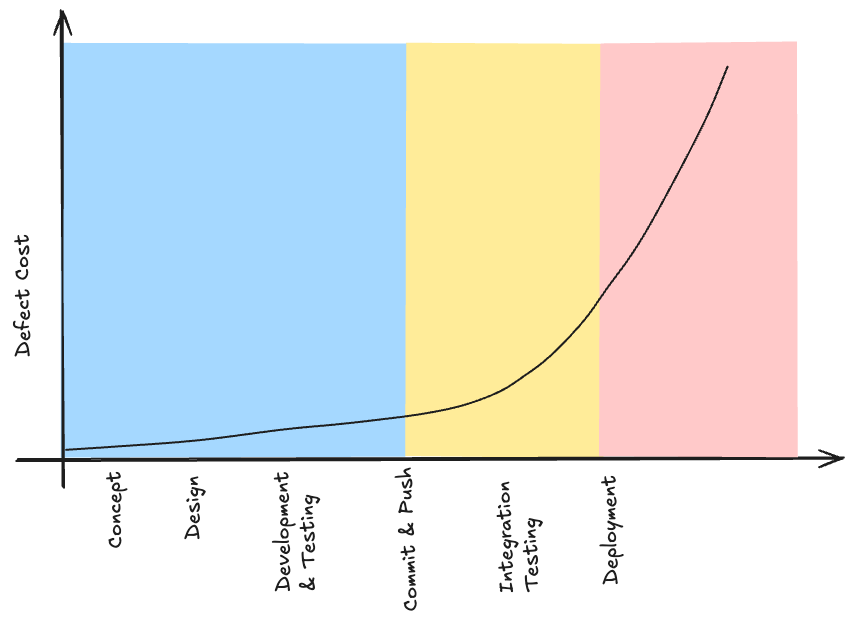
This is why in serious development life cycles and teams there is focus on tools to catch various types of problems as early as possible. Something like Pre-Commit hooks, linters, type checking, tests, and CI pipelines enforces the same standards and safety every time a change being added. Of course it would be perfect if we even can catch these issues before that.
I even argue that this matters even more now. With the current advancement of the AI tools, the speed and quantity of producing code started to surpass our ability to read and review the code with keen and careful eyes.
This situation requires us to put more time and effort into creating well established, strict guidelines and quality checks more than ever. This can be started with pre-commit hooks that watch both the correctness and style and carry through to the CI/CD.
Aside that, you also need to put guidelines on your code generation machine which is one step upstream. Right now, you can setup agent rules and instructions in every major AI coding agent available. Many are converging on shared conventions like AGENTS.md. A step further would be to create a separate agent that can read and review the generated code from your code generation agent and thus help you with finding problems at the same speed of the code generation.
This is a new era of the software development tools. AI reduces the cost of producing code, but it can increase the cost of validating it unless you move validation earlier. Treat your quality checks as part of the product: explicit standards, automated enforcement, and feedback that arrives while developers still have context.